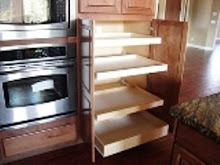
This is asked often by customers ordering pull out shelves for their own pantries through our web store http://www.slideoutshelvesllc.com
The first thing that needs to be done of course is to install the pull out shelves in the pantry. The following pictures show our double stack pull out shelves installed inside a pantry but even multiple single pull out shelves can be attached the same way.

Shelves installed inside the pantry
When installing the cabinet half of your slides, be sure the front edge of the slide is mounted as close the the outside edge as possible without protruding outside of the cabinet. This will make mounting the pantry door easier as described later. The picture shows our pull out shelves side mounted inside the pantry cabinet, but any mounting style will be acceptable. Below is a full extension slide, but the epoxy drawer slides mount the same way.

Slide attached to pantry cabinet
Once you have the cabinet part of the slides installed inside the pantry cabinet, you are ready to get the pull out shelves set to accept the pantry door.
We use double face tape to set our door placements. These square tape pads can be purchased at most hardware stores. The double faced tape will allow you to place the door squarely on the pantry cabinet before screwing the pull out shelves to the door. These pads will also allow minor adjustments in square.
Place a tape square on the bottom and top shelves as shown below

Next, clamp a cleat to the bottom of the pantry cabinet at the height you want the door bottom to be.
 Set your pantry door on this cleat, square the door to the pantry cabinet and press the door against the pull out shelves. The tape will hold the door temporarily until you can attach the pull out shelves to the door permanently.
Remove the bottom cleat and carefully slide the door open. This will expose the pull out shelves attached to the pantry door.
In each inside corner of the pull out shelves install a screw through the shelf front into the back of the pantry door. Always be sure that you are putting the screw into the fat or thickest part of the door. Most panty cabinet door frames are 3/4" thick, our shelves are 1/2" thick, so we use 1" drywall screws to attach the pull out shelves to the door.

Once you have attached the bottom and top shelves to the pantry door, slide any remaining shelves against the door and attach the same way.
Now your pantry shelves are attached to the pantry door and when you pull the pantry door open or close, all the pantry shelves roll into and out of the cabinet.
Below is a picture of a base kitchen cabinet with slide out shelves attached to the door
 All Pull Out Shelves shown can be purchased through our web store http://www.slideoutshelvesllc.com
They are custom made to fit existing cabinets
All photographs are copyright of Slide Out Shelves LLC and cannot be reproduced in any manner without written authorization from Slide Out Shelves LLC


 Posts
Posts